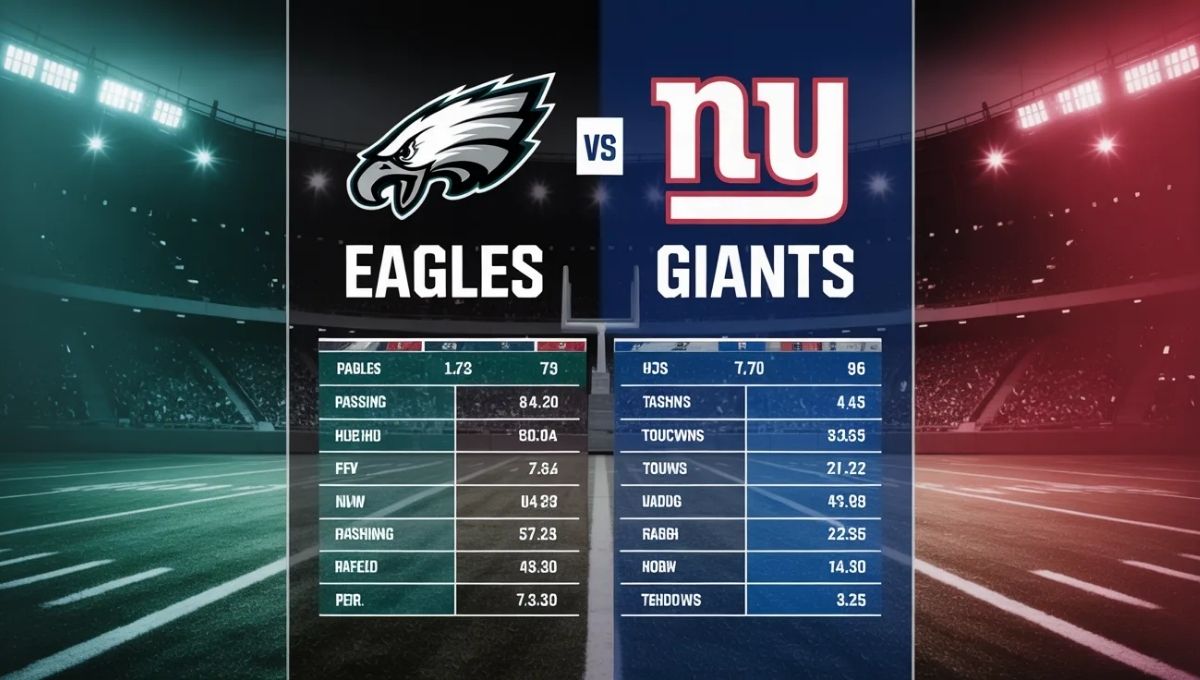
The Philadelphia Eagles vs New York Giants match player stats always attract attention across the NFL. These teams share one of the most intense rivalries in the NFC East division. Every meeting brings physical defense, aggressive play calling, and star players competing for dominance.
Fans often search for detailed breakdowns because box scores only tell part of the story. Passing efficiency, rushing production, defensive pressure, and situational football reveal the true difference between victory and defeat.
This guide delivers a deep statistical analysis of the matchup. You will see team comparisons, player performance tables, advanced metrics, and tactical insights. The article also explores a real game example to show how these numbers translate into results on the field.
Match Overview and Game Snapshot
When analysts examine new york giants vs philadelphia eagles match player stats, they usually begin with a quick game overview. This snapshot shows the basic facts that define the contest.
Match Biography Table
| Category | Details |
|---|---|
| Teams | Philadelphia Eagles vs New York Giants |
| League | National Football League (NFL) |
| Division | NFC East |
| Stadium | Lincoln Financial Field / MetLife Stadium |
| Typical Attendance | 70,000+ fans |
| Game Duration | Around 3 hours |
| Broadcast | FOX, NBC, ESPN, or NFL Network |
Both franchises belong to the oldest division in the NFL. The rivalry dates back to 1933, creating nearly a century of competition.
Key facts about the rivalry:
- The Eagles and Giants meet twice every regular season
- Both teams compete directly for NFC East playoff spots
- The rivalry includes over 180 total games
- Games frequently influence division standings
Because of that history, each matchup carries emotional intensity. Players understand the importance even if they are new to the roster.
Eagles vs Giants Rivalry History
Understanding philadelphia eagles vs new york giants match player stats becomes easier when you know the rivalry’s historical context.
Historical Head-to-Head Record
| Category | Statistic |
|---|---|
| First Meeting | October 15, 1933 |
| Total Games Played | 180+ |
| Eagles Wins | 90+ |
| Giants Wins | 80+ |
| Playoff Meetings | Several postseason matchups |
| Largest Margin of Victory | Eagles 54 – Giants 17 |
The rivalry has remained competitive for decades. At times the Giants controlled the division. Other seasons belonged to the Eagles.
Two factors keep the rivalry intense:
- Geographic proximity
- Division playoff stakes
Both fanbases travel well which means away games often feel like neutral territory.
Game Flow and Quarter Analysis
Football games shift momentum rapidly. A statistical breakdown shows when each team gained control.
Example Quarter-by-Quarter Score
| Quarter | Eagles | Giants |
|---|---|---|
| First Quarter | 7 | 0 |
| Second Quarter | 14 | 0 |
| Third Quarter | 10 | 0 |
| Fourth Quarter | 7 | 7 |
| Final Score | 38 | 7 |
This example comes from a 2023 playoff meeting where the Eagles dominated early.
The Giants struggled to move the ball during the first half. Meanwhile Philadelphia’s offense executed long drives that drained the clock.
Momentum changed briefly in the fourth quarter when New York finally scored. However the outcome was already decided.
Team Performance Comparison
A team comparison reveals how both squads performed in key statistical categories.
Team Match Statistics
| Team Statistic | Eagles | Giants |
|---|---|---|
| Total Yards | 416 | 227 |
| Passing Yards | 154 | 135 |
| Rushing Yards | 268 | 92 |
| Yards per Play | 6.3 | 4.1 |
| First Downs | 26 | 14 |
| Turnovers | 0 | 1 |
| Time of Possession | 33:15 | 26:45 |
These numbers show a clear pattern. Philadelphia dominated the ground attack which allowed them to control the game tempo.
Key takeaways:
- Eagles doubled the Giants in rushing yards
- Giants struggled converting third downs
- Philadelphia maintained ball control advantage
Ball control often decides divisional games. Teams that run efficiently keep opposing offenses off the field.
Philadelphia Eagles Player Stats
The Eagles rely on a balanced offense that mixes quarterback mobility with powerful rushing plays.
Quarterback Performance
| Player | Completions | Attempts | Passing Yards | TD | INT | Passer Rating |
|---|---|---|---|---|---|---|
| Jalen Hurts | 16 | 24 | 154 | 2 | 0 | 112.3 |
Jalen Hurts operates as the centerpiece of the offense.
His strengths include:
- Quick decision making
- Strong red-zone efficiency
- Dual-threat rushing ability
Hurts also excels at RPO (run-pass option) plays. These schemes force defenders to hesitate which opens running lanes.
A famous Eagles tactic is the “tush push” quarterback sneak. Philadelphia uses their powerful offensive line to push Hurts forward during short-yardage situations.
Eagles Rushing Leaders
The rushing attack frequently determines the outcome in philadelphia eagles vs new york giants match player stats.
| Player | Carries | Rushing Yards | Average | TD |
|---|---|---|---|---|
| Miles Sanders | 17 | 90 | 5.3 | 2 |
| Kenneth Gainwell | 12 | 112 | 9.3 | 1 |
| Jalen Hurts | 9 | 34 | 3.7 | 0 |
The Eagles rushing scheme uses zone blocking combined with quick cuts from running backs.
This strategy produces explosive runs because:
- Offensive linemen seal the edge
- Running backs attack gaps quickly
- Quarterback mobility freezes linebackers
Kenneth Gainwell delivered the most explosive run of the game with a 35-yard touchdown.
Eagles Receiving Leaders
Philadelphia spreads the ball among multiple receivers.
| Player | Receptions | Targets | Yards | TD |
|---|---|---|---|---|
| DeVonta Smith | 6 | 8 | 61 | 1 |
| Dallas Goedert | 5 | 7 | 58 | 0 |
| A.J. Brown | 3 | 6 | 22 | 1 |
Wide receiver DeVonta Smith led the team in receptions.
His route running stands out because he creates separation through quick footwork rather than physical size.
Tight end Dallas Goedert provides reliability in the middle of the field. Quarterbacks trust tight ends because they operate in high-traffic areas.
New York Giants Player Stats
The Giants offense relies heavily on creativity and quick adjustments.
Quarterback Performance
| Player | Completions | Attempts | Passing Yards | TD | INT |
|---|---|---|---|---|---|
| Daniel Jones | 15 | 27 | 135 | 0 | 1 |
Jones often performs best when he uses his mobility outside the pocket.
However the Eagles defensive line pressured him constantly.
Pressure forced rushed throws which reduced passing efficiency.
Giants Rushing Leaders
| Player | Carries | Yards | TD |
|---|---|---|---|
| Saquon Barkley | 9 | 61 | 0 |
| Daniel Jones | 4 | 24 | 0 |
| Matt Breida | 5 | 7 | 0 |
Running back Saquon Barkley remains one of the most explosive players in the league.
His running style combines:
- Burst acceleration
- Elite balance
- Vision through tight gaps
Unfortunately the Eagles defensive front limited Barkley to short gains.
Giants Receiving Leaders
| Player | Receptions | Yards | TD |
|---|---|---|---|
| Isaiah Hodgins | 7 | 105 | 1 |
| Richie James | 4 | 51 | 0 |
| Darius Slayton | 2 | 21 | 0 |
Wide receiver Isaiah Hodgins delivered the Giants’ best offensive performance.
He caught a deep touchdown pass late in the fourth quarter.
Still the offense lacked consistent production.
Defensive Player Stats and Impact
Defense often decides NFC East matchups.
Defensive Leaders
| Player | Team | Tackles | Sacks | Interceptions |
|---|---|---|---|---|
| Haason Reddick | Eagles | 4 | 1 | 0 |
| James Bradberry | Eagles | 3 | 0 | 1 |
| Kayvon Thibodeaux | Giants | 6 | 0 | 0 |
| Xavier McKinney | Giants | 5 | 0 | 0 |
Haason Reddick created constant pressure from the edge.
His speed forces offensive tackles to retreat quickly which collapses the pocket.
Meanwhile James Bradberry intercepted a pass that ended a Giants drive.
Pass Rush and Coverage Breakdown
The Eagles defense relies on one of the strongest defensive lines in the NFL.
Their front four includes:
- Edge rushers
- Interior pass disruptors
- Rotational depth
This group creates pressure without heavy blitzing.
Advantages of this strategy include:
- More defenders available in coverage
- Reduced risk of deep passes
- Consistent quarterback pressure
The Giants defense attempted several blitz packages. However Philadelphia’s offensive line handled them effectively.
Turnovers and Game-Changing Plays
Turnovers frequently shift momentum during games.
Key Turning Points
• Bradberry interception early in the third quarter
• Kenneth Gainwell touchdown run
• Eagles fourth-down conversion near midfield
• Giants stalled red-zone drive
Each moment affected field position and confidence.
Football analysts often repeat one phrase:
“Turnover margin decides close games.”
In this matchup the Eagles avoided mistakes. The Giants committed one interception.
That difference influenced the final score.
Special Teams and Situational Execution
Special teams rarely receive headlines. Still they quietly influence outcomes.
Kicking and Punting Stats
| Player | Team | Field Goals | Extra Points | Punt Average |
|---|---|---|---|---|
| Jake Elliott | Eagles | 1/1 | 5/5 | — |
| Jamie Gillan | Giants | — | 1/1 | 47.3 yards |
Jake Elliott remained perfect on scoring kicks.
Meanwhile punter Jamie Gillan delivered several strong punts that pinned the Eagles deep.
Special teams contribute in several ways:
- Field position advantage
- Reliable scoring opportunities
- Return yardage
Small details add up across four quarters.
Coaching Strategy and Game Planning
Coaches play a huge role in shaping new york giants vs philadelphia eagles match player stats.
Philadelphia Strategy
Head coach Nick Sirianni emphasized:
- Physical rushing attack
- Controlled passing game
- Defensive line pressure
This formula worked because the Eagles dominated both trenches.
Giants Strategy
The Giants attempted a different approach.
Their plan focused on:
- Quick passing plays
- Barkley running outside tackles
- Occasional deep throws
However consistent pressure disrupted their rhythm.
Advanced Analytics and Efficiency Metrics
Traditional stats tell only part of the story. Advanced analytics reveal deeper insights.
Advanced Efficiency Metrics
| Metric | Eagles | Giants |
|---|---|---|
| Third Down Conversion | 7/13 | 3/12 |
| Red Zone Efficiency | 4/5 | 1/3 |
| Average Drive Length | 7 plays | 5 plays |
| Yards Per Rush | 6.2 | 3.8 |
The Eagles dominated situational football.
Third-down conversions extend drives. Red-zone efficiency converts opportunities into touchdowns.
These two categories often separate contenders from struggling teams.
Case Study: 2023 NFC Divisional Playoff
A detailed case study helps explain the rivalry.
The Eagles hosted the Giants in the 2023 NFC Divisional Round.
Philadelphia dominated every phase of the game.
Key Game Statistics
| Category | Eagles | Giants |
|---|---|---|
| Total Yards | 416 | 227 |
| Rushing Yards | 268 | 92 |
| Passing TD | 2 | 0 |
| Turnovers | 0 | 1 |
Three major factors decided the outcome:
• Eagles offensive line dominance
• Defensive pressure on Daniel Jones
• Explosive rushing runs
The game proved that controlling the trenches still wins football games.
What These Stats Mean for the NFC East
Every philadelphia eagles vs new york giants match player stats analysis also reveals division implications.
The NFC East remains one of the most competitive divisions.
Recent seasons show:
- Eagles emerging as a Super Bowl contender
- Giants rebuilding with younger talent
- Division games determining playoff seeding
Winning division games increases postseason chances significantly.
Teams that sweep division opponents often secure playoff spots.
Key Player Performances to Watch in Future Matchups
Several players will shape future meetings.
Philadelphia Eagles Stars
• Jalen Hurts – elite dual-threat quarterback
• A.J. Brown – physical deep threat receiver
• Haason Reddick – explosive pass rusher
New York Giants Stars
• Saquon Barkley – elite rushing talent
• Kayvon Thibodeaux – young defensive star
• Daniel Jones – mobile quarterback with upside
If these players perform well the rivalry will remain competitive.
Expert Insight
NFL analysts often highlight one theme.
“Division games feel like playoff games because both teams know each other so well.”
That familiarity creates tighter defenses and more aggressive play calling.
Statistics become even more important because small advantages matter.
Conclusion
The philadelphia eagles vs new york giants match player stats reveal much more than a simple final score.
A detailed breakdown shows how games are truly won:
- Rushing efficiency
- Quarterback decision making
- Defensive pressure
- Turnover control
- Special teams execution
In the example matchup the Eagles dominated the ground game. Their offensive line created running lanes and controlled the tempo.
Meanwhile the Giants struggled under defensive pressure. That imbalance led to a convincing victory.
Future games will likely remain intense because the rivalry continues evolving.
Fans will always analyze new york giants vs philadelphia eagles match player stats to understand how these divisional battles unfold.
FAQs
Who usually wins Eagles vs Giants games?
The rivalry remains fairly balanced historically. However recent seasons have favored the Eagles.
Who is the most important player in the matchup?
Quarterbacks usually determine outcomes. Jalen Hurts and Daniel Jones influence offensive success.
What stat matters most in this rivalry?
Rushing yards often decide the winner. Teams that control the ground attack dominate possession.
How often do the Eagles and Giants play?
NFL scheduling places them in the same division. They play two regular season games every year.
Where can you check official player stats?
Official NFL statistics appear on these sites:
These sources provide complete box scores and advanced analytics.